Neuroprotective and anxiolytic effects of Matricaria chamomilla ethanolic extract against harmine-induced anxiety and oxidative stress in rats exposed to forced swimming stress
DOI:
https://doi.org/10.2298/ABS251001032HKeywords:
harmine, ethanolic extract, anxiety disorders, Matricaria chamomilla, adrenocorticotropic hormone (ACTH)Abstract
Paper description:
- Harmine, a β-carboline alkaloid, induces anxiogenic and oxidative effects. Chamomile provides calming antioxidant properties.
- Male Wistar rats were divided into six groups receiving harmine, the ethanolic extract of Matricaria chamomilla (EEC) (200 or 500 mg/kg), or their combination, and examined using behavioral experiments and biochemical markers.
- EEC counteracted harmine-induced anxiety, restoring oxidative balance, normalizing adrenocorticotropic hormone and acetylcholinesterase, and enhancing antioxidant enzymes.
- The results highlight chamomile’s potential as a natural therapeutic agent with anxiolytic and neuroprotective properties, offering an alternative approach to managing anxiety and oxidative disorders.
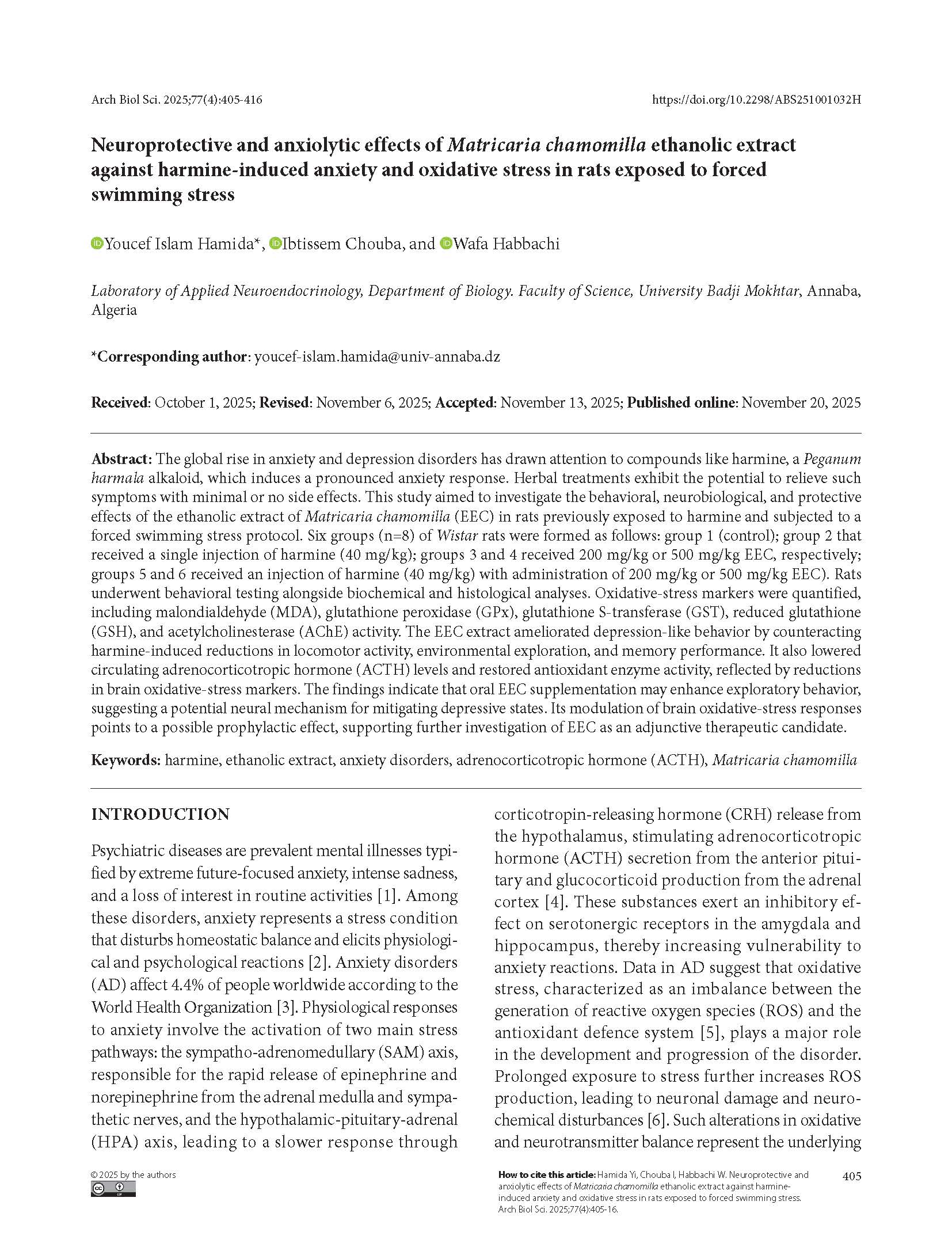
Abstract: The global rise in anxiety and depression disorders has drawn attention to compounds like harmine, a Peganum harmala alkaloid, which induces a pronounced anxiety response. Herbal treatments exhibit the potential to relieve such symptoms with minimal or no side effects. This study aimed to investigate the behavioral, neurobiological, and protective effects of the ethanolic extract of Matricaria chamomilla (EEC) in rats previously exposed to harmine and subjected to a forced swimming stress protocol. Six groups (n=8) of Wistar rats were formed as follows: group 1 (control); group 2 that received a single injection of harmine (40 mg/kg); groups 3 and 4 received 200 mg/kg or 500 mg/kg EEC, respectively; groups 5 and 6 received an injection of harmine (40 mg/kg) with administration of 200 mg/kg or 500 mg/kg EEC). Rats underwent behavioral testing alongside biochemical and histological analyses. Oxidative-stress markers were quantified, including malondialdehyde (MDA), glutathione peroxidase (GPx), glutathione S-transferase (GST), reduced glutathione (GSH), and acetylcholinesterase (AChE) activity. The EEC extract ameliorated depression-like behavior by counteracting harmine-induced reductions in locomotor activity, environmental exploration, and memory performance. It also lowered circulating adrenocorticotropic hormone (ACTH) levels and restored antioxidant enzyme activity, reflected by reductions in brain oxidative-stress markers. The findings indicate that oral EEC supplementation may enhance exploratory behavior, suggesting a potential neural mechanism for mitigating depressive states. Its modulation of brain oxidative-stress responses points to a possible prophylactic effect, supporting further investigation of EEC as an adjunctive therapeutic candidate.
Downloads
References
Liu H, Zhang X, Shi P, Yuan J, Jia Q, Pi C, Chen T, Xiong L, Chen J, Tang J, Yue R, Liu Z, Shen H, Zuo Y, Wei Y, Zhao L. α7 Nicotinic acetylcholine receptor: a key receptor in the cholinergic anti-inflammatory pathway exerting an antidepressant effect. J Neuroinflammation. 2023;20(1):84.
https://doi.org/10.1186/s12974-023-02768-z
Elfakharany SA, Eskaros SS, Azhary NME, Abdelmonsif DA, Zeitoun TM, Ammar GA, Hatem YA. Neuroprotective Role of Selenium Nanoparticles Against Behavioral, Neurobiochemical and Histological Alterations in Rats Subjected to Chronic Restraint Stress. Mol Neurobiol. 2024;61(12):10159-81.
https://doi.org/10.1007/s12035-024-04196-3
World Health Organization. Depressive disorder (depression) [Internet]. Geneva: World Health Organization; 2025 Aug 29 [cited 2025 Nov 19]. Available from: https://www.who.int/news-room/fact-sheets/detail/depression
Chu B, Marwaha K, Sanvictores T, Awosika AO, Ayers D. Physiology, stress reaction [Internet]. Treasure Island (FL): StatPearls Publishing; 2024 Jan– [cited 2025 Nov 19]. Available from: https://www.ncbi.nlm.nih.gov/books/NBK541120/
Juszczyk G, Mikulska J, Kasperek K, Pietrzak D, Mrozek W, Herbet M. Chronic Stress and Oxidative Stress as Common Factors of the Pathogenesis of Depression and Alzheimer’s Disease: The Role of Antioxidants in Prevention and Treatment. Antioxidants. 2021;10(9):14-39.
https://doi.org/10.3390/antiox10091439
Wu CDT, Li X, Li T, Cai M, Yu Z, Zhang J, Zhang Z, Zhang W, Xiang J. Apocynum venetum leaf extract exerts antidepressant-like effects and inhibits hippocampal and cortical apoptosis of rats exposed to chronic unpredictable mild stress. Evid Based Complement Altern Med. 2018;2018:5916451.
https://doi.org/10.1155/2018/5916451
Shabani M, Naderi R. Phytohormone abscisic acid elicits positive effects on harmaline‐induced cognitive and motor disturbances in a rat model of essential tremor. Brain Behav. 2022;12(5).
https://doi.org/10.1002/brb3.2564
Urbanska N, Ashaolu TJ, Mattova S, Simko P, Kiskova T. The Potential of Selected Plants and Their Biologically Active Molecules in the Treatment of Depression and Anxiety Disorders. Int J Mol Sci. 2025;26(5):23-68.
https://doi.org/10.3390/ijms26052368
Ioniță R. Anxiolytic and antidepressant effects of matricaria chamomilla hydroalcoholic extract in a rat model of scopolamine. Farmacia. 2019;67(1):68-72.
https://doi.org/10.31925/farmacia.2019.1.9
Ionita R, Postu PA, Mihasan M, Gorgan DL, Hancianu M, Cioanca O, Hritcu L. Ameliorative effects of Matricaria chamomilla L. hydroalcoholic extract on scopolamine-induced memory impairment in rats: A behavioral and molecular study. Phytomedicine. 2018;47:113-20.
https://doi.org/10.1016/j.phymed.2018.04.049
Aksoy L, Sözbilir NB. Effects of Matricaria chamomilla L. on lipid peroxidation, antioxidant enzyme systems, and key liver enzymes in CCl 4 -treated rats. Toxicol Environ Chem. 2012;94(9):1780-88. https://doi.org/10.1080/02772248.2012.729837
Ranpariya VL, Parmar SK, Sheth NR, Chandrashekhar VM. Neuroprotective activity of Matricaria recutita against fluoride-induced stress in rats. Pharm Biol. 2011;49(7):696-701.
https://doi.org/10.3109/13880209.2010.540249
Al-Snafi AE, Lawahidh FH. Bioactive constituents and pharmacological importance of Matricaria chamomilla: A recent review GSC. Biol Pharm Sci. 2023;22(2):079-98.
https://doi.org/10.30574/gscbps.2023.22.2.0477
Moloudizargari M, Mikaili P, Aghajanshakeri S, Asghari M, Shayegh J. Pharmacological and therapeutic effects of Peganum harmala and its main alkaloids. Pharmacogn Rev. 2013;7(14):199. https://doi.org/10.4103/0973-7847.120524
Asgharzade S, Rabiei Z, Rafieian-Kopaei M. Effects of Matricaria chamomilla extract on motor coordination impairment induced by scopolamine in rats. Asian Pac J Trop Biomed. 2015;5(10):829-33. https://doi.org/10.1016/j.apjtb.2015.06.006
Jiang P, Dang RL, Li HD, Zhang LH, Zhu WY, Xue Y, Tang MM. The Impacts of Swimming Exercise on Hippocampal Expression of Neurotrophic Factors in Rats Exposed to Chronic Unpredictable Mild Stress. Evidence-Based Complement. Altern Med. 2014:1-8.
https://doi.org/10.1155/2014/729827
Hall CS. Emotional behavior in the rat. I. Defecation and urination as measures of individual differences in emotionality. J Comp Psychol.1934;18(3):385-403.
https://doi.org/10.1037/h0071444
Pellow S, Chopin P, File SE, Briley M. Validation of open : closed arm entries in an elevated plus-maze as a measure of anxiety in the rat. J Neurosci Methods. 1985;14(3):149-67.
https://doi.org/10.1016/0165-0270(85)90031-7
Brossaud J, Bouton M, Gatta B, Tabarin A, Corcuff JB. Use of an automated ACTH assay for the diagnosis of pituitary and adrenal-related diseases. Clin Biochem. 2011;44(13):1160-62.
https://doi.org/10.1016/j.clinbiochem.2011.06.002
Weckbecker CJG. Ribonucleotide reductase activity and growth of glutathione depended mouse leukaemia L 1210 cells n vitro. Cancer Lett. 1988;40:257-64.
https://doi.org/10.1016/0304-3835(88)90084-5
Ohkawa YKH, Ohishi N. Assay for lipid peroxides in animal tissues by thiobarbituric acid reaction. Anal Biochem. 1979;95(2):351-58.
https://doi.org/10.1016/0003-2697(79)90738-3
Bradford MM. A rapid and sensitive method for the quantitation of microgram quantities of protein utilizing the principle of protein-dye binding. Anal Biochem.1976;72(1-2):248-54.
https://doi.org/10.1016/0003-2697(76)90527-3
Flohé L, Günzler WA. Assays of Gluthathione Peroxidase. Methods Enzymol.1984;105:114-20.
https://doi.org/10.1016/s0076-6879(84)05015-1
Habig WB, Pabst WH, Jakoby MJ. Glutathione S-transferases: the first enzymatic step in mercapturic acid formation. J Biol Chem. 1974;249(22):7130-39.
https://doi.org/10.1016/S0021-9258(19)42083-8
Ellman GL, Courtney KD, Andres V. A new and rapid colorimetric determination of acetylcholinesterase activity. Biochem Pharmacol. 1961;7:88-95.
https://doi.org/10.1016/0006-2952(61)90145-9
Bettihi S, Mahdeb N, Bouzidi A. Evaluation of Maternal Toxicity in Rats Exposed to the Total Extract of the Alkaloids in the seeds of Peganum harmala L. during Pregnancy. Turkish J Agric Food Sci Technol. 2022;10(10):2067-75.
https://doi.org/10.24925/turjaf.v10i10.2067-2075.5491
Rahimi Shourmasti F, Goudarzi I, Lashkarbolouki T, Abrari K, Elahdadi Salmani M, Goudarzi A. Effects of riluzole on harmaline induced tremor and ataxia in rats: Biochemical, histological and behavioral studies. Eur J Pharmacol. 2012;695(1-3):40-7.
https://doi.org/10.1016/j.ejphar.2012.08.014
Smith KL, Ford GK, Jessop DS, Finn DP. Behavioural, neurochemical and neuroendocrine effects of the endogenous β-carboline harmane in fear-conditioned rats. J Psychopharmacol. 2013;27(2):162-70.
https://doi.org/10.1177/0269881112460108
Glennon DK, Lee RA, Rangisetty M, Dukat JB, Roth M, Savage BL, Savage JE, Bride AM, Rauser L, Hufeisen S, Lee DKH. 2-Substituted tryptamines: agents with selectivity for 5-HT6 serotonin receptors. J Med Chem. 2000;43(5):1011-18.
https://doi.org/10.1021/jm990550b
Nichols DE. Psychedelics. Pharmacol Rev. 2016;68(2):264-355.
https://doi.org/https://doi.org/10.1124/pr.115.011478
Glennon RA. β-Carbolines as ligands for the benzodiazepine receptor. Drug Dev Res. 2011;48:3-9.
https://doi.org/10.1002/ddr.430480103
Xia J , Wang H , Zhang C , Liu B , Li Y , Li K , Li P, Song C. The comparison of sex differences in depression-like behaviors and neuroinflammatory changes in a rat model of depression induced by chronic stress. Frontiers in Behavioral Neuroscience. 2022;16.
https://doi.org/10.3389/fnbeh.2022.1059594
Jiang B, Meng L, Zou N, Wang H, Li S, Huang L, Cheng X, Z Wang Z, Chen W, Wang C. Mechanism-based pharmacokinetics-pharmacodynamics studies of harmine and harmaline on neurotransmitters regulatory effects in healthy rats: Challenge on monoamine oxidase and acetylcholinesterase inhibition. Phytomedicine. 2019;62:152967.
https://doi.org/10.1016/j.phymed.2019.152967
Wasim AM, Sakeel A, Mohd R, Swamita A,Khalid SH, Khalid RV, Sameer A, Faraz A. An updated comprehensive review of the therapeutic properties of Chamomile (Matricaria chamomilla L.). Int J Food Prop. 2024;27(1):133-64.
https://doi.org/10.1080/10942912.2023.2293661
Faiq STA, Ahmad S, Wasim M, Khan A, Manzoor Arain F, Batool Z, Khaliq SSH, Samad N. Antidepressive and anxiolytic effects of a combination of Saffron and Chamomile in rats and their relationship with serotonin using in vivo methods. J Tradit Chinese Med. 2025;45(1):49-56.
https://doi.org/10.19852/j.cnki.jtcm.2025.01.005
Jiawen GCL, Tianwei M, Chaojie W, Weiping C, Qi Z. Natural products for the treatment of depression: Insights into signal pathways influencing the hypothalamic-pituitary-adrenal axis. Med. 2023;102(3):44.
https://doi.org/10.1097/MD.0000000000035862
Srivastava JK, Shankar E, Gupta S. Chamomile : A herbal medicine of the past with a bright future. Mol Med Report 1. 2010;3(6):896-901.
https://doi.org/10.3892/mmr.2010.377
Alibabaei Z, Rabiei Z, Rahnama S, Mokhtari S, Rafieian-kopaei M. Matricaria Chamomilla extract demonstrates antioxidant properties against elevated rat brain oxidative status induced by amnestic dose of scopolamine. Biomed. Aging Pathol. 2014;4(4):355-60.
https://doi.org/10.1016/j.biomag.2014.07.003
Briyal S, Ranjan AK, Gulati A. Oxidative stress: A target to treat Alzheimer’s disease and stroke. Neurochem Int. 2023;165:105-509.
https://doi.org/10.1016/j.neuint.2023.105509
Brierley M, Hibberd SM, Costa TJ. The endocannabinoid system and the gut-brain axis. Neurogastroenterol Motility. 2012;24(7):687-97.
https://doi.org/10.1111/j.1365-2982.2012.01944.x
Zhanaidarova GU, Yessimova RZH, Nurseitova KT, Seidakhmetova RB, Arystan LI, Adekenov SM, Nauryzov NN, Berikbaeva BK. Experimental research of Harmine hydrochloride effect on internal organs. Bangladesh J Med Sci. 2019;18(3):598-606.
https://doi.org/10.3329/bjms.v18i3.41635
Youxu W, Hanxue W, Liuhong Z, Yunpeng Z, Yuchen S, Gang D, Shuping L, Ning C, Huida G, Xuemei C, Changhong W. Subchronic toxicity and concomitant toxicokinetics of long-term oral administration of total alkaloid extracts from seeds of Peganum harmala Linn: A 28-day study in rats. J Ethnopharmacol. 2019;238:111866.
https://doi.org/10.1016/j.jep.2019.111866
Jabri MA, Limas-Nzouzi N, Eto B, Sebai H. Chamomile decoction modulates water, neutral NaCl and electrogenic ionic exchange in mice intestinal epithelium. Food Biosci. 2020;35:100608.
Downloads
Published
How to Cite
Issue
Section
License
Copyright (c) 2025 Youcef Islam Hamida, Ibtissem Chouba, Wafa Habbachi

This work is licensed under a Creative Commons Attribution 4.0 International License.
Authors grant the journal right of first publication with the work simultaneously licensed under a Creative Commons Attribution 4.0 International License that allows others to share the work with an acknowledgment of the work’s authorship and initial publication in this journal.